November 11, 2026
Many of the strongest onshore wind sites sit on ridges, hilltops and escarpments, where the terrain speeds the wind up. They are also the sites where early yield estimates are least certain, because the wind flow modelling that handles steep terrain usually comes later in development.
That means one of the biggest sources of uncertainty in a complex-terrain project is often answered after a lot of time and budget has already gone into it.
Instead of treating CFD as a separate specialist exercise, Prospect CFD brings it directly into the design process, where its results can inform turbine placement, energy yield and project economics.
Most early-stage wind resource work uses linearised flow models. They are fast, well proven and do a good job on gentle and moderately hilly ground, which is why the industry has relied on them for decades.
The limitation is steep terrain. As a rule of thumb, slopes exceeding approximately 17° increase the likelihood of flow separation, which linearised models cannot adequately represent and may therefore lead to reduced accuracy.
Computational fluid dynamics (CFD) simulates how air moves through a space by solving the physical equations of fluid flow. Applied to a wind site, it builds a 3D model of the terrain and calculates how the wind behaves as it passes over and around it.
Unlike linearised models, CFD can represent more complex flow behaviour, including the effects of steep slopes, sharp ridges and sheltered valleys. This makes it particularly valuable for sites where simpler models reach their limits.
The trade-off has traditionally been computational cost and complexity. CFD requires significantly more computing power than linearised models and has often involved specialist setup and expertise. As a result, it has typically been used selectively, particularly for complex sites or more detailed assessments, rather than as part of routine, iterative design workflows.
Prospect CFD is built on OpenFOAM, the open-source CFD toolbox widely used in engineering and wind energy research. It solves the steady-state Reynolds-averaged Navier–Stokes (RANS) equations using a k–ε turbulence model.
The engine uses detailed terrain data and surface roughness to model how wind accelerates over ridges, slows down in sheltered areas, and changes direction around complex terrain. A three-dimensional computational mesh follows the landscape, with higher resolution near the ground where terrain effects are strongest. The model can use terrain from the public domain, or you can bring your own.
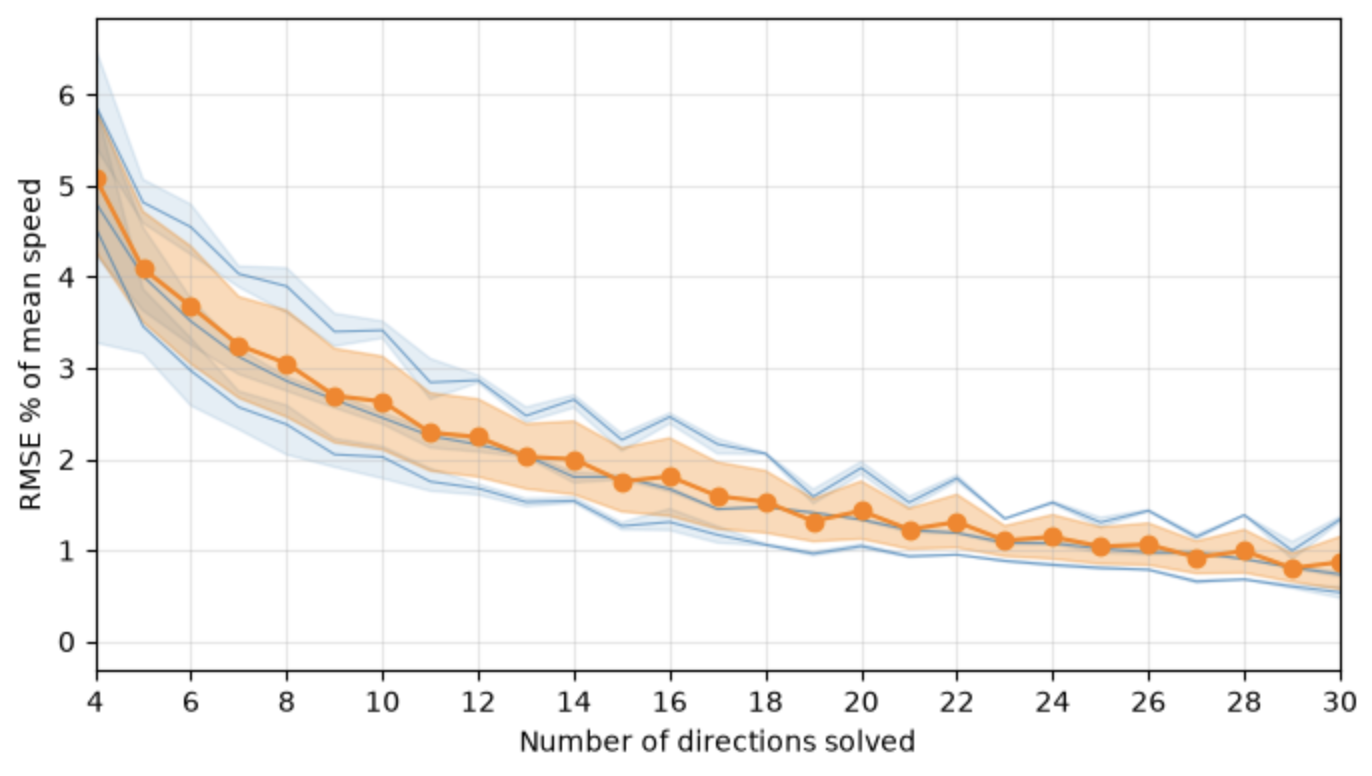
The model has also been tested against established wind measurement campaigns, including the Askervein Hill and Bolund case, to assess its performance in both gentle and complex terrain. Being able to validate against real-life measurements is critical to determine the reliability of the model. In sum, the Prospect CFD was better than half of the submitted runs in the study.
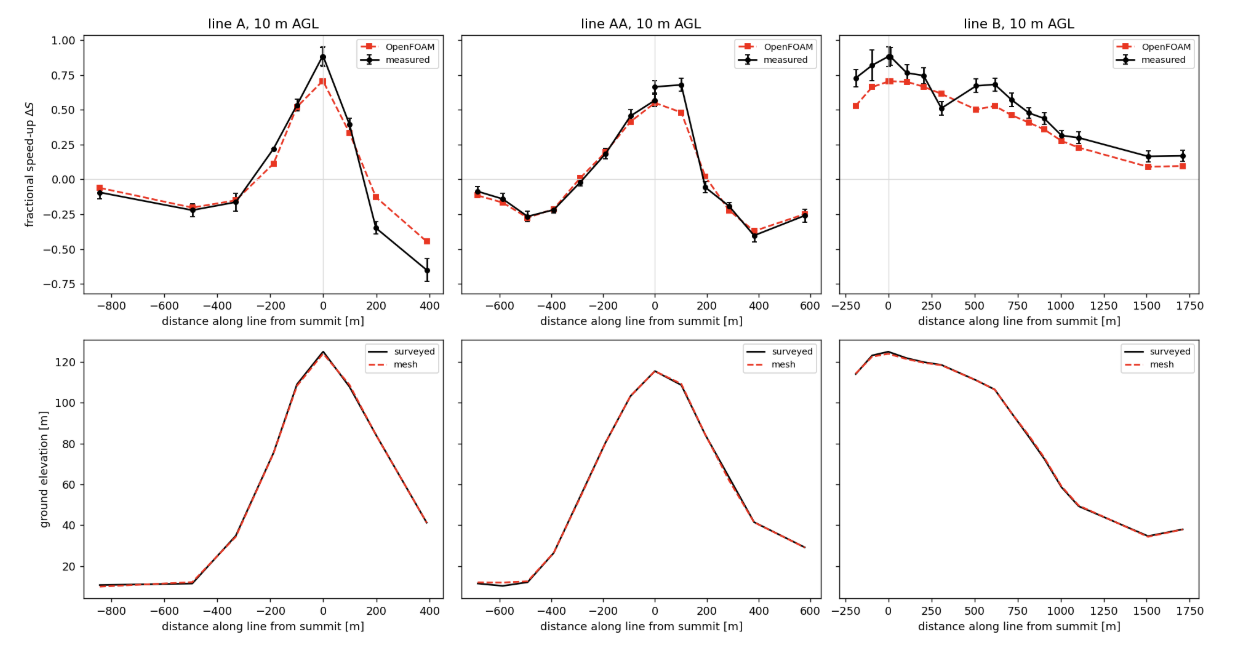
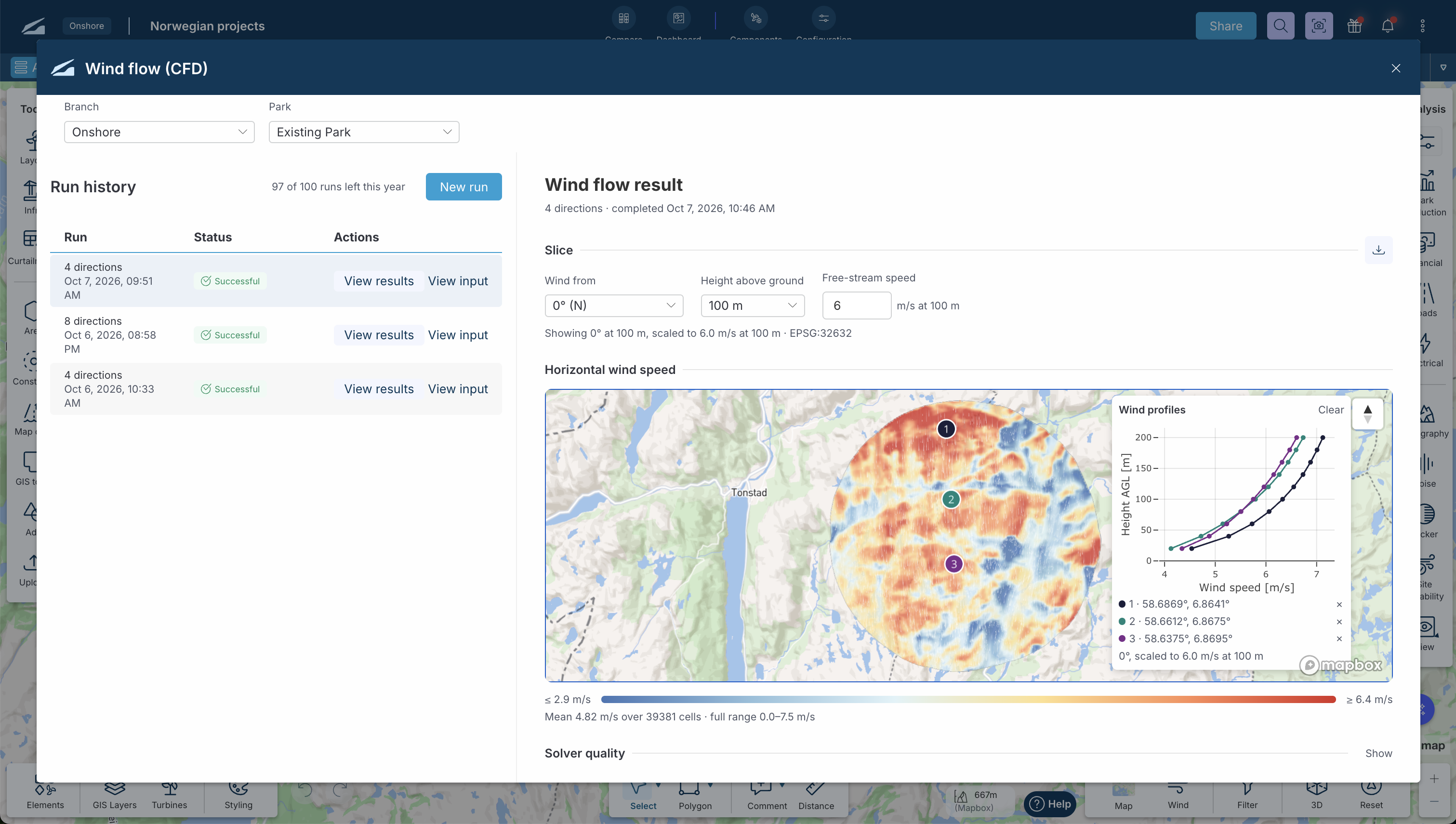
Prospect CFD was built in-house and runs directly inside the platform. A run takes about an hour and fits into the workflow you already use:
Prospect CFD sits alongside other flow and wake analyses in the platform, including DNV's CFD.ML, WAsP by DTU, and integration Whiffle for LES simulations. Each with different use cases and strengths.
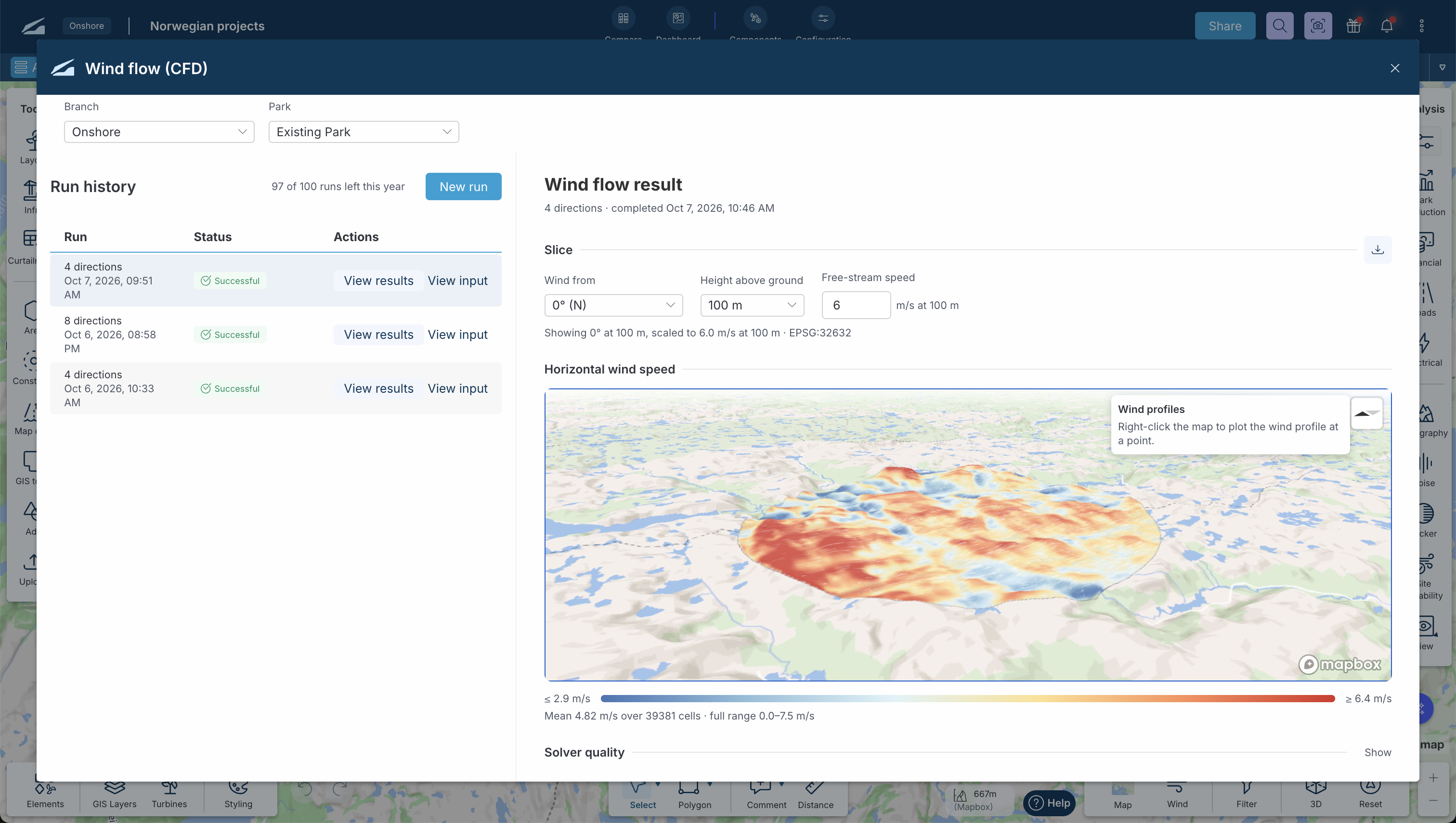
For project developers, the main change is timing. You can see how terrain shapes the wind across a complex site at the screening stage, before committing serious time to it. That makes it easier to rule out weak sites early, take a closer look at promising ones that a simpler model might have undervalued, and walk into internal discussions with a more realistic picture of the site.
For yield specialists, Prospect CFD is a stronger starting point, not a replacement for later in-depth CFD tools. Projects reach them with the terrain effects already visible, and the flow result is traceable inside the project. The detailed assessments and validation that specialists carry out later in development stay exactly where they are.
Taken together, this means fewer surprises between screening and the detailed yield assessment, and more of the team's time spent on the sites most likely to succeed.
The full method is documented in our help centre, so if you are a customer, your technical teams can review it anytime.
Prospect CFD is now available to selected customers in Vind AI. Speak to your customer success manager about access and pricing. If you are working on complex-terrain sites and want to see it on your own projects, contact us or book a demo.
Please reach out if you are interested in seeing a demo, asking a question or sharing feedback.